
الخلاصة
This guide explores the key differences between knitted wool fabric and traditional woven wool materials, covering manufacturing methods, fabric structures, performance characteristics, and application suitability. It provides textile manufacturers and procurement professionals with practical insights into material selection, cost-performance considerations, and product development strategies for apparel, home textiles, and technical applications.
By understanding how knitted wool fabric compares with traditional wool materials in terms of comfort, durability, thermal performance, and production flexibility, buyers can make more informed sourcing decisions. This analysis also highlights essential factors such as quality requirements, application needs, and industry standards to support efficient and reliable B2B textile procurement.
Structural Differences Between Knitted and Traditional Woven Wool Fabrics
Manufacturing Process and Yarn Configuration
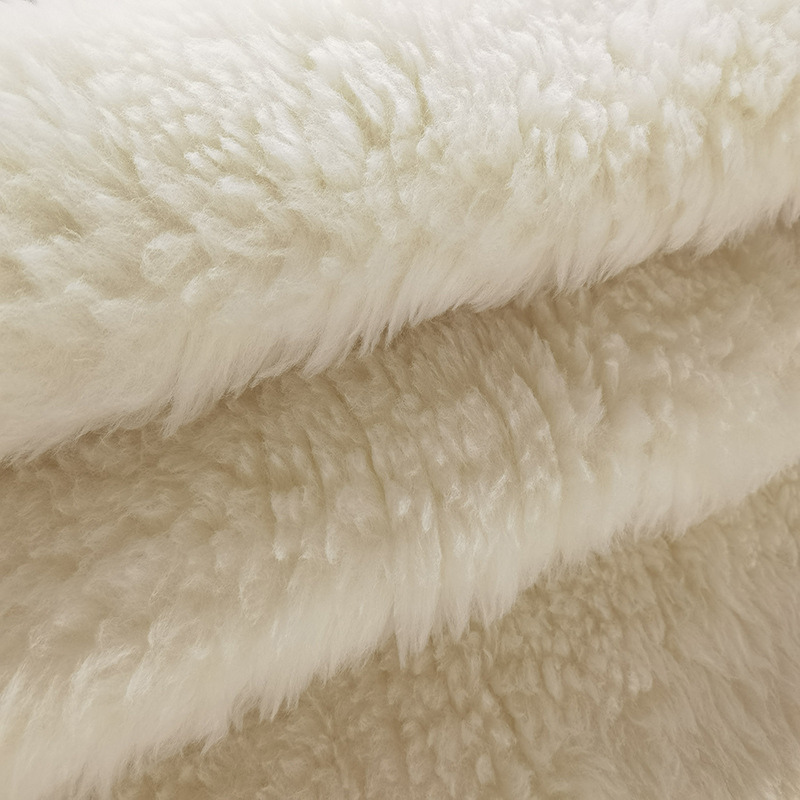
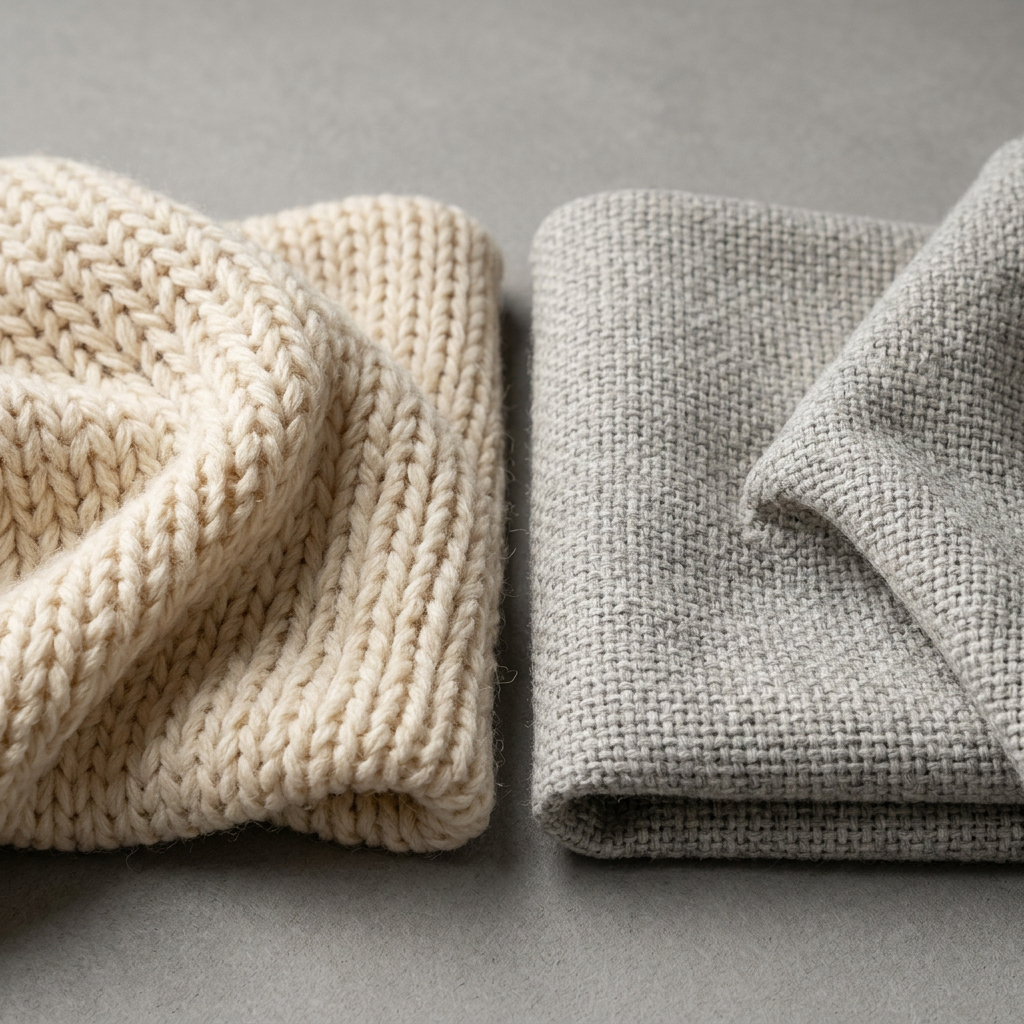
أقمشة صوف محبوكة is produced through interlocking yarn loops using circular or flatbed knitting machines, where a single continuous yarn forms horizontal courses and vertical wales. This loop-based construction enables modern electronic knitting equipment to achieve production speeds of 1.2–2.5 meters per minute. The process applies minimal tension to fibers, helping preserve wool’s natural crimp, softness, and elasticity. Manufacturers benefit from reduced yarn breakage rates (typically 0.3–0.8% compared with 1.5–3% in weaving) and the ability to create seamless tubular constructions for activewear and performance apparel.
Traditional woven wool materials utilize perpendicular warp and weft yarn systems produced on rapier, air-jet, or dobby looms. The interlacing process requires higher yarn tension (150–300 cN) and preliminary sizing treatments to strengthen warp threads, increasing raw material preparation costs by 8–12%. Production speeds range from 0.8–1.5 meters per minute depending on fabric density and pattern complexity. Weaving excels in producing stable, structured fabrics with precise dimensional control, making it ideal for tailored garments that require long-term shape retention.
The machinery investment also differs significantly between the two production methods. Industrial circular knitting machines typically cost $45,000–$120,000 and require less floor space (15–25 m²), while rapier looms range from $65,000–$180,000 and occupy 30–45 m² per unit. Knitting systems provide faster style changeovers (2–4 hours compared with 6–10 hours for loom rethreading), offering manufacturers greater flexibility for customized orders and short production runs.
The main manufacturing differences between knitted and woven wool fabrics include:
- Yarn construction: Knitting creates interconnected loops, while weaving relies on perpendicular warp and weft structures.
- Production flexibility: Knitting supports faster style changes and smaller customized batches.
- Fabric stability: Woven wool provides stronger dimensional control for structured applications.
- Processing efficiency: Knitted production generally requires fewer preparation steps before manufacturing.
Fabric Architecture and Physical Properties
The loop structure of أقمشة صوف محبوكة creates natural bi-directional stretch, typically achieving 30–60% elongation in the course direction and 15–35% in the wale direction without elastane addition. This mechanical stretch comes from loop geometry rather than fiber modification, allowing the material to provide comfortable body conformity for apparel applications. The open structure improves breathability, reaching 180–350 mm/s air permeability according to ASTM D737, making knitted wool suitable for base layers, outdoor clothing, and lightweight insulation products.
However, dimensional stability requires careful consideration during production. Knitted fabrics may experience 4–8% relaxation shrinkage after the first wash compared with 1–3% for woven materials. Manufacturers typically address this through pre-shrinking treatments or pattern compensation, which may add $0.35–$0.65 per meter to processing costs. The loop structure also creates directional differences in strength, requiring proper fabric orientation during garment cutting.
Woven wool fabrics demonstrate superior dimensional stability due to their tightly interlaced yarn structure. The locked construction provides uniform strength in both warp and weft directions, typically achieving 400–650 N tensile strength per 5 cm width according to ISO 13934-1. This makes woven wool suitable for structured garments such as blazers, coats, and formalwear. Surface texture remains consistent through multiple cleaning cycles, maintaining a professional appearance in corporate wear applications.
Although woven materials provide excellent structure and durability, they lack inherent stretch and require more complex dart and seam construction to achieve body fit. In contrast, أقمشة صوف محبوكة offers greater flexibility and comfort through its natural elasticity, making it a preferred option for products where mobility and wearing comfort are important.
Key performance differences include:
Knitted Wool Fabric:
- Higher stretchability and improved body adaptability
- Better breathability for lightweight and active apparel
- Softer hand feel and enhanced wearing comfort
Traditional Woven Wool:
- Superior dimensional stability and shape retention
- Higher structural strength for formal garments
- Consistent appearance after repeated use and cleaning
Performance Comparison: Key Technical Parameters
Mechanical Properties and Durability
Tensile strength analysis reveals woven wool’s structural advantage: plain weave wool fabrics achieve 450-700 N/5cm in the warp direction, while comparable weight knitted wool measures 250-420 N/5cm in the wales direction. This 40-55% strength differential makes woven materials preferable for applications involving mechanical stress, such as upholstery (requiring ≥400 N per EN 14465) or heavy-duty workwear. The interlaced yarn configuration distributes load across multiple contact points, preventing catastrophic failure from single yarn breakage.
Abrasion resistance testing per Martindale method (ISO 12947) demonstrates woven wool’s superiority: medium-weight woven wool withstands 25,000-40,000 cycles before visible wear, compared to 15,000-28,000 cycles for knitted equivalents at similar fabric weight (250-300 g/m²). This performance gap narrows with tight-gauge knitting (12-14 gauge) but increases processing time by 35-50%, negating knitted fabric’s production speed advantage.
Pilling tendency inversely correlates with fabric tightness. Knitted wool’s loop structure creates surface fibers more prone to entanglement, typically grading 3-3.5 on the 5-point scale per ASTM D3511 after 5,000 rubs, while tightly woven wool achieves grades 4-4.5. Manufacturers address this through enzymatic finishing or compact spinning techniques, adding $0.45-$0.80 per meter, but essential for premium product positioning.
Recovery from deformation showcases knitted wool’s advantage: loop structures return to original dimensions after 5% extension within 2-4 minutes, while woven fabrics retain 15-25% permanent deformation under identical conditions. This elastic recovery makes knitted wool superior for garments requiring repeated stretch cycles—knee areas in trousers, elbow zones in sweaters, and necklines in base layers.
Thermal and Moisture Management
Insulation efficiency depends on the trapped air volume within the fabric structure. Knitted wool’s three-dimensional loop architecture creates 40-55% air content versus 25-35% in woven fabrics of comparable weight, resulting in thermal resistance values of 1.8-2.4 Clo for 300 g/m² knitted fabric compared to 1.4-1.9 Clo for woven equivalents. This 20-30% insulation advantage positions knitted wool as the preferred material for mid-layer garments in technical outdoor apparel, where warmth-to-weight ratio directly impacts consumer performance.
Moisture management reveals nuanced differences. Wool fiber’s hygroscopic capacity (16-18% moisture regain) remains constant regardless of fabric structure, but vapor transmission varies significantly. Knitted constructions demonstrate 15-25% faster moisture vapor transmission rates (3,500-5,200 g/m²/24hr per ASTM E96) due to open-loop pathways, critical for active insulation layers that must transport perspiration while maintaining warmth. Woven fabrics’ tighter construction provides better wind resistance (5-15 cfm air permeability versus 40-85 cfm for knits), making them suitable for outer shell applications.
Quick-dry performance testing shows knitted wool fabrics release 60% of absorbed moisture within 90 minutes of active wear, compared to 40-50% for woven materials at equivalent thickness. This 20-35% performance differential stems from increased surface area exposure in loop structures, allowing faster evaporation. For athletic and travel apparel markets, this translates to reduced odor development and extended wear between laundering cycles.
Comparative Performance Metrics Table
| المعلمة | أقمشة صوف محبوكة | Traditional Woven Wool | Testing Standard |
|---|---|---|---|
| Stretch Recovery (%) | 85-95% | 35-55% | ISO 14704-1 |
| Air Permeability (mm/s) | 180-350 | 45-120 | ASTM D737 |
| Thermal Resistance (Clo) | 1.8-2.4 | 1.4-1.9 | ASTM F1868 |
| Pilling Grade (5-point scale) | 3.0-3.5 | 4.0-4.5 | ASTM D3511 |
| معدل الانكماش (%) | 4-8% | 1-3% | ISO 6330 |
| Weight Range (g/m²) | 180-400 | 220-550 | ISO 3801 |
| Abrasion Resistance (cycles) | 15,000-28,000 | 25,000-40,000 | ISO 12947 |
Application Scenarios and Market Positioning
Knitted Wool Fabric Optimal Use Cases
Activewear applications leverage knitted wool’s stretch and moisture management properties. Base layer systems for skiing, hiking, and cycling utilize 180-240 g/m² merino wool knits with 18.5-21.5 micron fiber diameter, achieving next-to-skin comfort while maintaining thermal regulation during variable-intensity activities. Market data indicates 23% annual growth in the technical wool activewear segment from 2020-2024, driven by consumer preference for natural performance fibers over synthetic alternatives.
Layering garments represent knitted wool’s largest market segment, encompassing sweaters, cardigans, and hooded mid-layers. The fabric’s drape characteristics and body-conforming stretch eliminate the boxy silhouettes associated with traditional woven wool, appealing to contemporary fashion preferences. Seamless knitting technology enables manufacturers to produce zero-waste garments with strategic ventilation zones and articulated fits, reducing cutting room waste by 15-25% compared to cut-and-sew woven construction.
Seamless construction products utilize circular knitting’s tubular output for socks, sleeves, and body-mapped base layers. This eliminates chafing seams critical in endurance sports applications, where friction causes 40-60% of comfort complaints per industry surveys. The ability to vary stitch density within a single garment—tighter knit at abrasion zones, more open at high-perspiration areas—creates performance advantages unachievable with woven materials requiring assembly from multiple fabric pieces.
Technical sportswear increasingly specifies knitted wool for shoulder season conditions (5-15°C ambient temperature) where synthetic insulation proves too warm and woven shells lack breathability. The fabric’s 30-50% stretch accommodates dynamic movement in climbing, trail running, and cross-country skiing without restrictive seaming or gusset insertions required in woven garment construction.
Traditional Woven Wool Material Advantages
Tailored suiting remains woven wool’s dominant application, where dimensional stability and crisp hand-feel define product quality. Worsted wool fabrics (220-320 g/m²) with thread counts of 60-80 ends per inch maintain sharp creases and structured silhouettes essential for business formal wear. The fabric’s minimal stretch prevents knee bagging and elbow distortion during extended wear, critical for garments expected to maintain appearance through 8-12 hour workdays over 2-3 year lifecycles.
Outerwear applications exploit woven wool’s wind resistance and abrasion durability. Overcoats, peacoats, and blazers utilize 380-550 g/m² melton or broadcloth constructions that provide weather protection while maintaining breathability superior to coated synthetic alternatives. The fabric’s high density (warp density 45-65 ends/cm) blocks wind penetration without membrane lamination, appealing to heritage brands and sustainability-focused consumers avoiding fluorocarbon treatments.
Upholstery markets specify woven wool for commercial and residential furniture requiring 40,000+ Martindale abrasion cycles and flame resistance per TB 117-2013 standards. The interlaced structure withstands repeated compression without permanent deformation, maintaining its appearance through a 7-10 year service life. Woven wool’s natural flame resistance (LOI 24-26% per ASTM D2863) eliminates chemical flame retardant treatments required for synthetic upholstery, addressing growing regulatory restrictions in California and EU markets.
Industrial filtration and technical applications leverage woven wool’s precise pore size control and chemical resistance. Needle felts for dust collection, press felts for paper manufacturing, and polishing cloths for optical components require the dimensional accuracy achievable only through controlled weaving parameters. These niche applications command $8-$25 per meter pricing, compared to $4-$12 for apparel-grade woven wool.
Selection Criteria for Textile Manufacturers
Cost-Benefit Analysis and Supply Chain Considerations
Cost Efficiency and Material Utilization
Raw material efficiency is one of the key advantages of knitted construction. Compared with woven fabrics of equivalent weight, knitted wool fabric typically uses 8–15% less yarn per square meter, resulting in approximately $0.60–$1.40 savings per meter depending on wool prices.
This advantage is particularly significant in lightweight fabric categories (180–240 g/m²), where knitted structures can provide sufficient coverage and comfort while maintaining lower material consumption.
Key cost advantages of knitted wool fabric include:
- Lower yarn consumption for lightweight applications
- Reduced material waste during production
- Better cost control for high-volume apparel manufacturing
- Improved flexibility for product development
Production Scalability and Manufacturing Flexibility
Production efficiency differs significantly between knitting and weaving technologies. Circular knitting machines can produce approximately 25–45 kg of fabric per 8-hour shift with single-operator supervision, while rapier looms typically produce 18–32 kg under similar conditions.
However, the advantage of knitting depends on the application. For wide-width fabrics above 180 cm, flat-bed knitting efficiency may decrease by 40–55%, making woven production more suitable for home textiles, upholstery, and other applications requiring widths of 280–320 cm.
MOQ and Lead Time Considerations
Minimum order quantities are closely related to machinery setup requirements. Knitted fabric suppliers typically support 300–800 meter orders due to faster style changes, while woven mills often require 1,200–2,500 meter minimums because of warp preparation and loom setup costs.
For brands developing seasonal collections, customized colors, or limited product lines, lower MOQs help reduce inventory risks and improve cash flow flexibility.
Production lead times also differ between the two methods:
| Production Type | Typical Lead Time |
|---|---|
| Knitted wool fabric | 12–18 days |
| Woven wool fabric | 18–28 days |
The shorter production cycle of knitted fabrics allows suppliers to respond faster to changing market demands and compressed product development schedules.
Compliance and Quality Standards
Certification and Dimensional Stability Requirements
Wool certification requirements apply to both knitted and woven fabrics. Wool Mark standards require ≥93% wool content for pure wool labeling and ≥50% wool content for wool-blend products.
However, knitted fabrics require stricter dimensional stability control due to their loop structure. Testing standards typically require knitted fabrics to maintain shrinkage within acceptable limits after repeated washing, while woven materials naturally benefit from stronger yarn interlacement.
Manufacturers usually improve stability through:
- Relaxation treatment
- Pre-shrinking processes
- إعداد البخار
- Controlled finishing procedures
Chemical Safety and Testing Requirements
OEKO-TEX Standard 100 certification focuses on chemical safety rather than fabric construction. Due to their more open structure and higher surface area, knitted wool fabrics may absorb more dye during processing, requiring careful control of dye selection and chemical residues.
Key testing requirements include:
- pH value control
- Formaldehyde limitation
- Restricted substance compliance
- Use of certified dyestuffs
Supplier auditing and quality management remain essential to ensure consistent compliance across production batches.
Dimensional Accuracy and Care Labeling
ISO 5077 provides testing guidelines for dimensional changes in textile materials. Knitted fabrics require additional attention to skew distortion because loop structures may shift during finishing, affecting garment assembly accuracy.
Woven fabrics generally provide better dimensional stability due to their fixed warp and weft structure, while knitted fabrics require additional finishing controls to maintain production consistency.
Care labeling requirements also differ between the two fabric types. Knitted wool products often require gentler washing recommendations due to their flexible structure, while woven wool garments typically provide greater washing stability.
Proper care instructions help improve consumer experience, reduce product returns, and support long-term brand reputation.
وحدة الأسئلة الشائعة
Q1: What is the typical stretch ratio difference between knitted and woven wool fabrics?
Knitted wool fabrics typically provide 30–60% stretch in the course direction and 15–35% in the wale direction without elastane, thanks to their loop-based structure. Traditional woven wool fabrics usually offer only 5–12% stretch from yarn relaxation and often require elastane blending or additional pattern engineering for improved flexibility.
This makes knitted wool more suitable for activewear, base layers, and comfort-focused garments, while woven wool remains preferred for structured apparel requiring shape retention.
Q2: Can knitted wool fabrics meet the durability requirements of outerwear applications?
Yes, knitted wool fabrics can meet many outerwear requirements when produced with tight-gauge construction and dense stitch patterns. They typically achieve 18,000–25,000 Martindale cycles, making them suitable for sweater jackets, mid-layers, and flexible outer garments.
However, woven wool fabrics generally provide higher abrasion resistance (30,000–45,000 Martindale cycles) and remain the better choice for heavy-duty coats, professional workwear, and applications requiring maximum shape stability and wind resistance.
Q3: How do production costs compare between knitted and woven wool textiles?
Knitted wool fabric typically costs $8.50–$14.20 per meter for standard weights, benefiting from efficient yarn usage, faster production speeds, and lower preparation requirements. Woven wool generally costs $9.80–$16.50 per meter due to additional processes such as warp preparation and sizing treatments.
For B2B buyers, total cost considerations should include minimum order quantities. Knitted wool fabrics often support lower MOQs (300–800m), helping reduce inventory pressure and improve cash flow flexibility compared with traditional woven wool production.
الخاتمة
Choosing between knitted wool fabric and traditional woven wool requires careful consideration of application needs, performance expectations, and production goals. Knitted constructions provide excellent stretch, comfort, breathability, and thermal performance, making them suitable for activewear, base layers, and comfort-focused apparel. Woven wool materials offer superior dimensional stability, structure retention, and durability for tailored garments, outerwear, and applications requiring precise shape control.
For textile manufacturers and buyers, the right choice depends on balancing product requirements, production efficiency, and cost considerations. By understanding the unique advantages of each fabric construction, suppliers can develop more competitive products and make more effective sourcing decisions across different market segments.